
Packaging
Packed to survive the journey
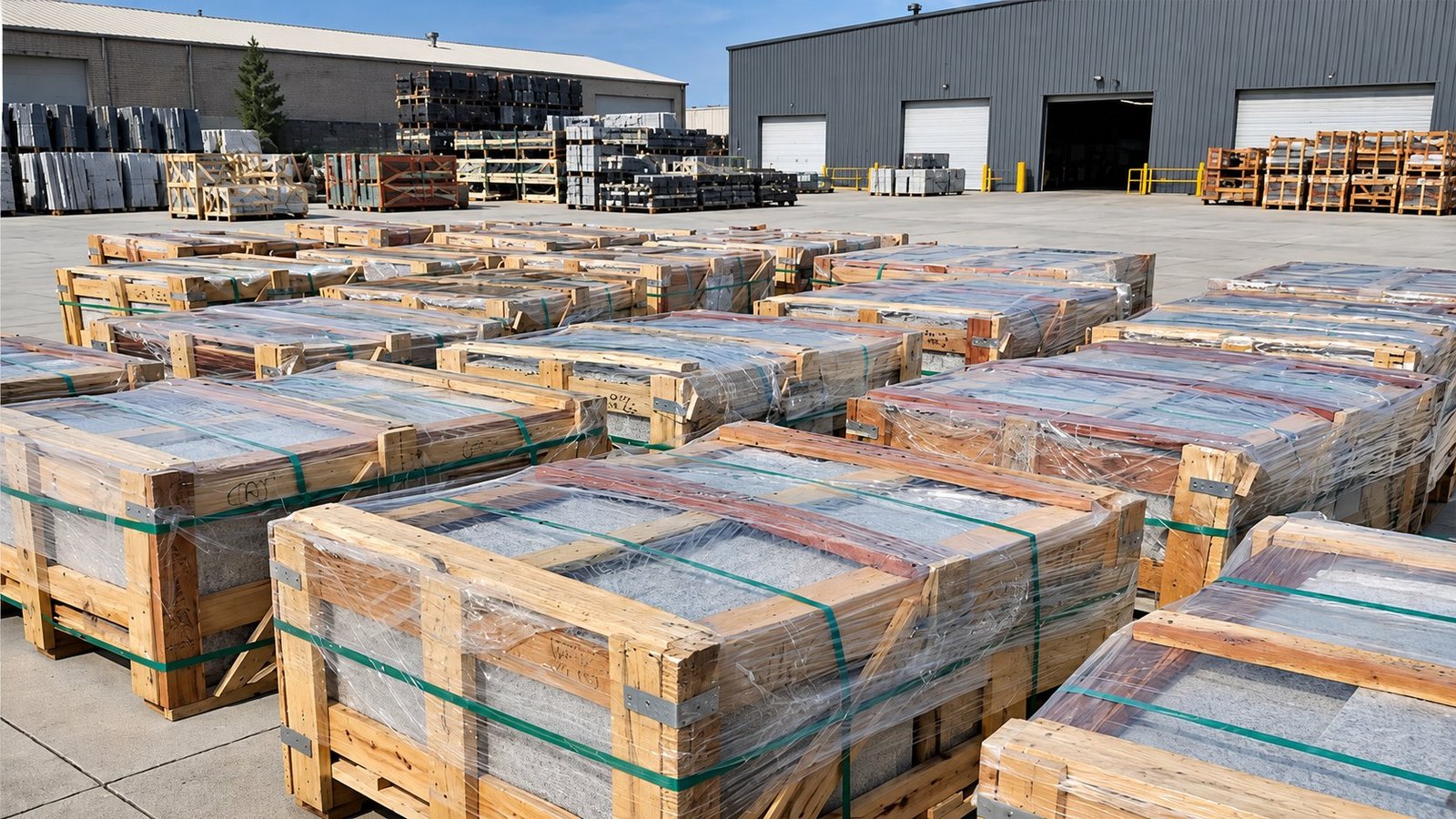
Stone that arrives chipped is stone you cannot sell. Packing is the last thing we do to an order and the first thing you judge it on.
Method
Six stages from finished slab to sealed container
The order is deliberate. Protection goes on before handling, not after, because most transit damage is done in the yard rather than at sea.
Film wrapping
Each slab or component is wrapped in plastic film before it is handled again, so the finished face is never exposed to grit on the shop floor.
Foam interleaving
EPE foam sheet is laid between every surface. Stone on stone rubs itself dull over six weeks at sea; foam is what stops it.
Edge & corner protection
Rubber or foam guards go onto the vulnerable edges — polished slabs and countertops chip at the corner long before they crack in the middle.
Crate construction
Bundles are built into heat-treated, fumigated timber crates and onto moisture-resistant pallets, so the wood clears plant-quarantine inspection at the destination.
Marking & labelling
Every crate is marked with the shade, dimensions, thickness, batch and handling instructions, so your yard can sort a container without opening it.
Stuffing & securing
Crates are stuffed tight, blocked and braced with dunnage, and desiccants are added before the doors are sealed under supervision.
Materials
What goes into a crate
Heat-treated timber
Crating stock is heat-treated and fumigated to meet the wood-packaging rules that apply to stone consignments entering most markets.
EPE foam sheet
Closed-cell foam between surfaces absorbs the vibration a container transmits over a long sea passage.
Moisture barriers
Waterproof polythene or tarpaulin over the bundle, and desiccants inside the container, against rain, spray and container sweat.
Corner guards
Rubber and foam profiles on exposed arrises, applied before the bundle is strapped rather than after.
Dunnage & bracing
Timber blocking fills the voids so nothing in the container has room to move once it is on the road.
Custom packing
Tiles, slabs and cut-to-size each pack differently. Tell us how the material will be unloaded and we will crate it to suit.
Compliance
Packing that clears inspection
Wood packaging is the part of a stone shipment most likely to be stopped at the border. Treated timber, a legible treatment mark and accurate crate declarations are what keep a container moving.
If your market has a specific requirement we have not listed, raise it at the enquiry stage — it is far cheaper to pack for it than to re-pack on arrival.
- Timber treatment mark
- Available on request
- Typical crate weight
- Available on request
- Slabs per bundle
- Available on request
- Custom packing
- Available on request
How it is packed
Every crate, photographed
Crating, sealing, wrapping and container stuffing, plus the fumigation and moisture checks each consignment goes through.
-
Hot Fumigation -
Moisture Test 1 -
Moisture Test 2 -
Moisture Test 3 -
Normal Fumigation 1 -
Normal Fumigation 2 -
Packaging -
Wooden Frame For Gangsaw -
Crate Packing -
Crate Sealing 1 -
Crate Sealing 2 -
Granite Gangsaw Slab Packing -
Granite Gangsaw Slabs Container Stuffing -
Granite Monument Outer Packing -
Granite Monument Packing -
Granite Monument Wrapping -
Granite Pool Coping Crate Stuffing